01
Two-way voice translation
Support a conversation where each participant speaks their own language.
I’m an independent developer focused on practical AI applications—especially voice, real-time pipelines, and the engineering needed to turn model capabilities into usable software.
A real-time voice translation desktop app, built around a simple requirement: the conversation should keep moving while the software listens, translates, and speaks.
ClearCommit is a Python desktop application for two-way live voice translation. One side’s speech is recognized and translated into English captions, while the user’s microphone is translated into the other language and delivered as speech.
The project focuses on connecting speech recognition, translation, and text-to-speech into a usable live pipeline—not treating each model call as an isolated demo.
Technology names describe components used in the project; exact availability depends on local configuration and provider credentials. No credentials are included on this page.
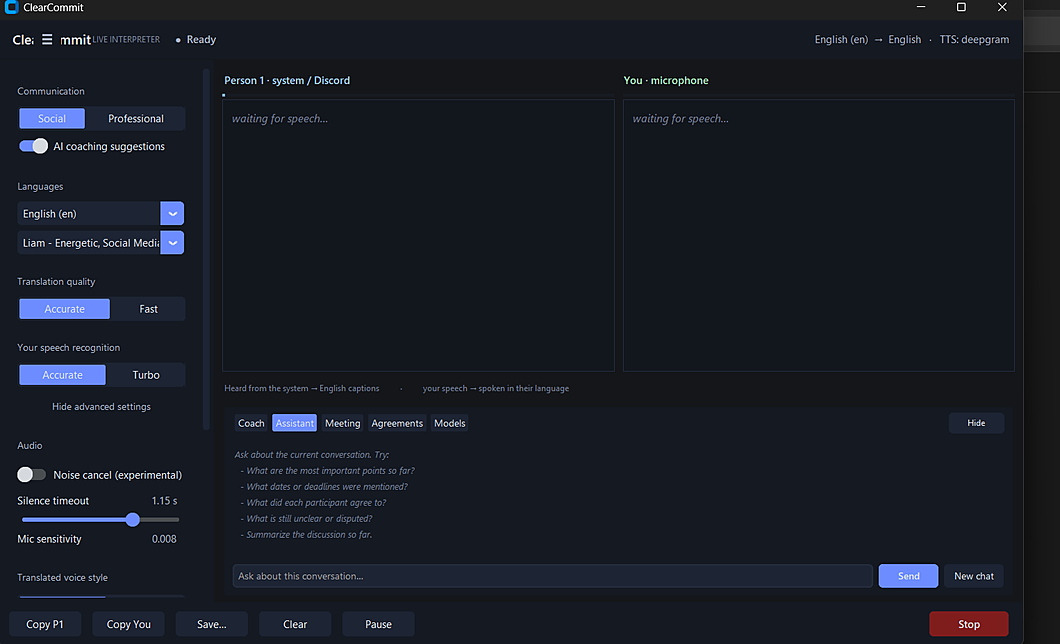
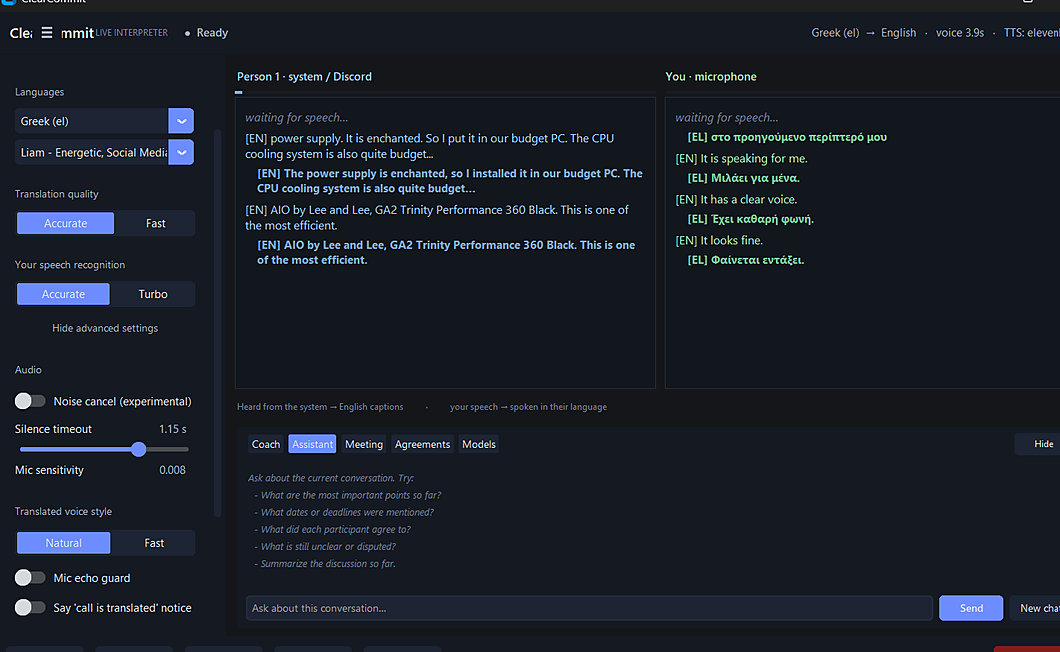
Support a conversation where each participant speaks their own language.
Turn recognized speech into translated text and translated audio through a desktop interface.
Account for issues such as noisy input, echo, recognition errors, and the timing of live turns.
The core interpreter is the established part of the project. Additional AI coaching and meeting workflows should be treated as in development until individually connected and validated in real conversations.
I’m most interested in the unglamorous work that makes an AI feature dependable: wiring systems together, finding failure modes, measuring real behavior, and improving the product without breaking what already works.
Connect model APIs to a real product flow, manage inputs and outputs, and keep optional AI features from breaking the core experience.
Trace issues across components, reproduce failures, and make focused changes instead of rewriting working systems unnecessarily.
Define a small testable scope, verify behavior with realistic scenarios, and report what works, what fails, and what remains uncertain.
Keep the demo centered on a real user problem, a coherent workflow, and evidence that the feature actually works.
I’m interested in collaborating with people who want to build, test, and ship a useful prototype. For a hackathon, I prefer a clear scope, frequent communication, and concrete deliverables.